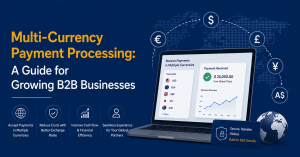
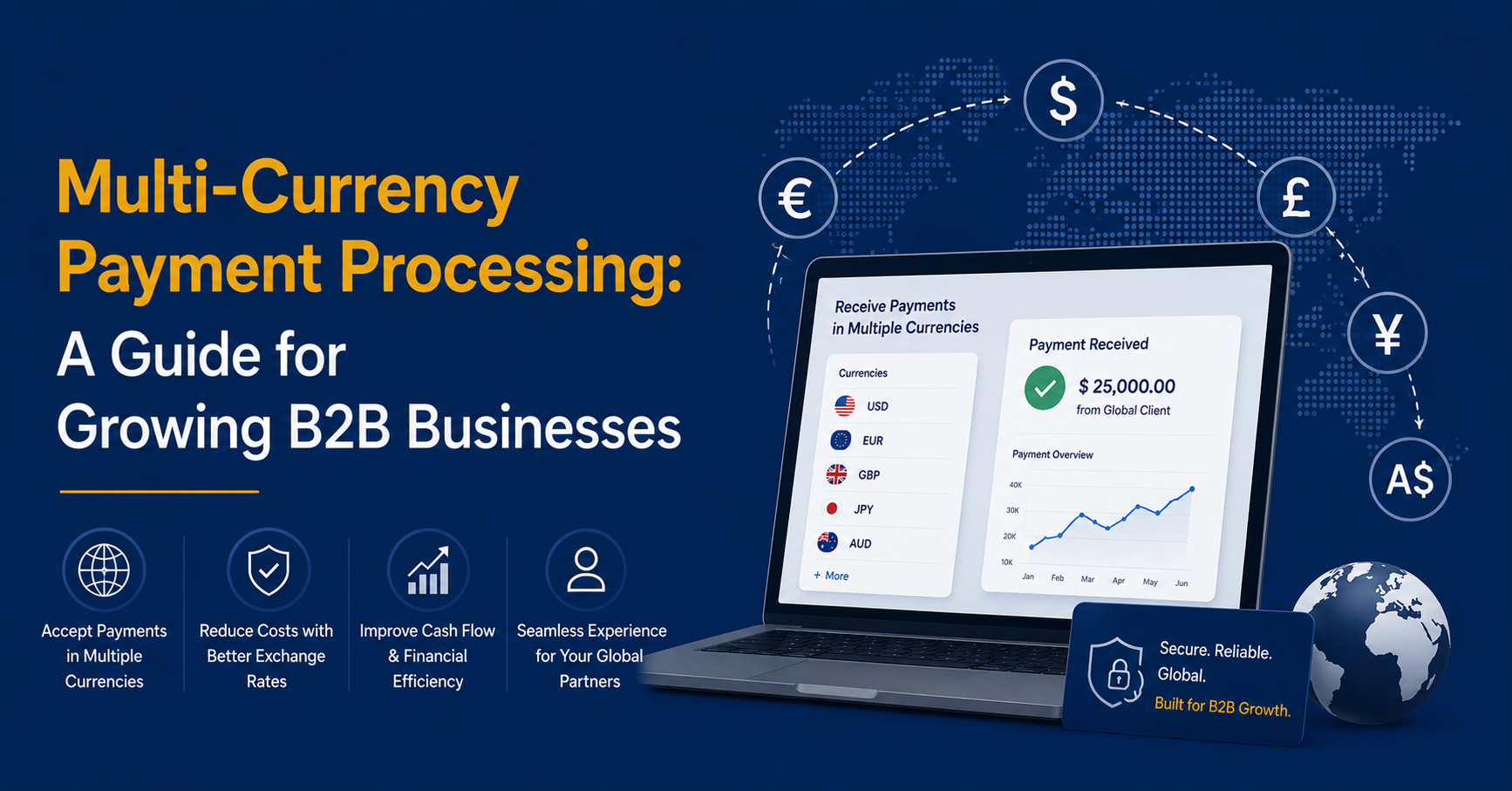
Every B2B business that begins selling internationally hits the same wall at some point: a customer in Germany wants to pay in euros, a supplier in Singapore expects Singapore dollars, and your finance team is stuck reconciling five different currencies in a system that was only ever built for one. That’s when multi-currency payment processing stops being a ‘nice to have’ and becomes a core part of your revenue infrastructure.
In this guide, we’ll break down what multi-currency payment processing actually means for B2B businesses, how a multi-currency payment gateway works, and what to look out for as you scale.
What is Multi-currency Payment Processing ?
Multi-currency payment processing allows you to accept, process and settle payments in currencies other than your company’s home currency. without having to route every transaction through one default currency first. In a B2B business this tends to come up in a few places:
- Charge customers overseas in their currency
- Accepting payments in multiple countries thru bank transfer, card or ACH-equivalent rails
- Settle funds into local or multi-currency accounts if you don’t always convert back to USD (or your base currency)
- No manual spreadsheet gymnastics to reconcile accounts receivable across currencies
The goal is simple. Let your customers pay the way they want to pay, in the currency they think in, and your finance team keeps clean, accurate books.
Why this is more important for B2B than for B2C
For consumer businesses, you can often get away with one checkout currency and let the customer’s card network handle the conversion. B2B is different for a couple of reasons:
- So bigger deal sizes, bigger FX risk. If a consumer buys $ 500 , currency movements are easily absorbed . A $250,000 enterprise contract doesn’t. A few percentage points of currency movement between invoice date and payment date can have a meaningful impact on margin.
- Extended payment terms. B2B invoices usually have 30, 60 or 90 day terms. That’s a lot of time for currency rates to move, so dealing with currency is a real financial risk and not simply a UX preference.
- The invoice will be issued in the local currency. In some cases, procurement teams need quotes and invoices to be in their own currency for their internal budgeting and approval processes. Quoting the wrong currency can kill or stall a deal before it even gets off the ground.
- Reconciliation is a bit more complicated. B2B finance teams reconcile invoices, purchase orders and payments, often across ERP systems. Work multiplied. Multiple currencies without the right processing infrastructure.
How A Multi Currency Payment Gateway Works
This is where the multi currency payment gateway comes in. It sits between your business and the banking networks and handles the mechanics of accepting and converting currency. In general, this is often what it does:
- Currency presentment : Displaying prices and invoices in the customer’s local currency at checkout or on the invoice.
- Payment acceptance : acceptance of local payment methods and rails (not just international cards) as many B2B buyers pay via bank transfer or local payment schemes rather than credit cards.
- FX conversion : conversion of incoming funds either at the point of payment or at settlement (as configured in the gateway).
- Settlement : crediting the money to your account, either in the original currency (if you have multi-currency accounts) or your base currency
- Reconciliation data : sending transaction and FX data back into your accounting or ERP system so finance can reconcile payments to invoices with zero manual work.
The best gateways let you choose when to convert and where to send the money, instead of automatically converting at whatever rate is offered that day.
Multi-Currency Processing – What to Watch For
Looking at providers, these are the things that usually differentiate a truly useful multi-currency setup from one that just makes things more complicated:
- FX rates are straightforward. Instead of hiding the margin in the exchange rate itself, look for providers that are upfront about the mid-market rate and their markup.
- Multi-currency transaction accounts Rather than auto-converting every payment you can hold balances in a variety of currencies and make international payments or payroll in different currencies without having to convert each time.
- Support for local payment methods Bank transfers, direct debits and local B2B payment rails are more important than card payments in many markets.
- ERP & accounting integration Native integrations to systems like NetSuite, QuickBooks or SAP can save a lot of reconciliation time.
- Local currency billing is ongoing. Your billing system should automatically create invoices in the customer’s currency based on their location or the terms of their contract.
- Tax and compliance management. Multi-currency processing often crosses over with VAT, GST and other cross-border tax obligations, so your provider should back this, not leave it up to you.
- Clear audit trail. Every conversion, fee, and settlement should be traceable for finance and audit purposes.
Typical problems faced by businesses
- Hidden FX markups. Many providers advertise “no conversion fees” but include a markup in the exchange rate itself. Always ask for the actual spread over mid market rate.
- Broken reconciliation. And without integration to your accounting system, finance teams are left to manually match payments across currencies which doesn’t scale well as transaction volume grows.
- Customer experience is not consistent. Issuing invoices in your currency, but accepting payments in their currency, can confuse customers as to the actual amount due, resulting in underpayment or delayed payments.
- Cash flow transparency. Having balances in different currencies can make it difficult to get a clear picture of the cash you have available unless your provider or accounting system does this automatically.
Hands On Approach To Getting Started
- Map your currency exposures. Know the currencies your customers and suppliers use and the amount of revenue or spend in each currency.
- Choose Your Settlement Strategy Do you immediately convert everything to your base currency, or do you keep multi-currency balances to pay international obligations directly?
- Select a gateway based on your volume and geography. A company that processes a handful of currencies has different needs than one operating in twenty markets.
- Connect to your existing finance stack. Look for ERP/accounting integrations with the vendors, not just manual exports.
- Develop FX risk policies in-house. Hedge large contracts . Pass the currency risk to the customer contractually . Absorb the risk as a cost of doing business .
The Bottom Line
Multi-currency payment processing is more than just accepting more currencies; it’s about providing a frictionless way for your international customers to pay, protecting your margins from the volatility of currency fluctuations and keeping your finance team’s reconciliation workload manageable as you grow. Get this right from the outset for growing B2B businesses and you avoid a much more painful retrofit later on when deal volume and currency exposure have both grown significantly.
The standard for judging providers is that the right multi-currency payment gateway should be invisible to your customers and easy for your finance team.