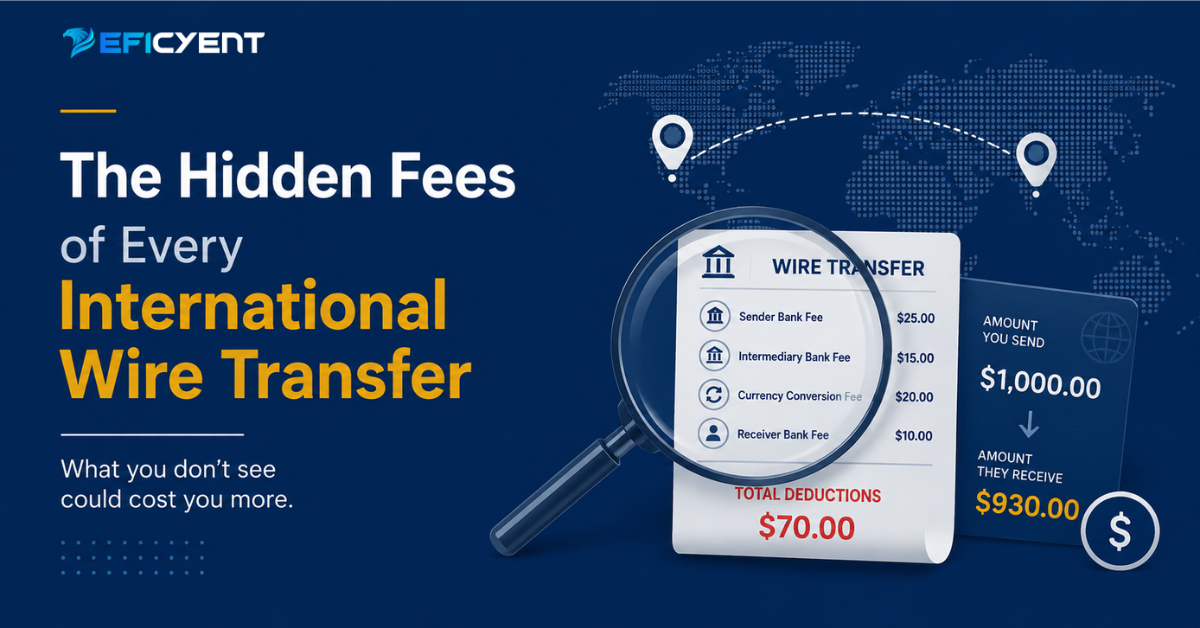
You authorize the payment of $10,000. Your recipient will get $9,720. There was no invoice for the missing $280. It got lost somewhere between your bank and theirs.
If you have ever sent money across borders you probably know the scenario. Wire transfer fees are rarely a single item. They’re a series of smaller wire transfer charges, some obvious, some hidden, that accrue long before the money even reaches its destination. To get a handle on these international bank transfer charges and what a realistic wire transfer international fee actually looks like you need to understand where they come from
Why Are Wire Transfers So Expensive?
On the surface, a wire transfer is simple: money moves from one account to another. In reality, an international wire travels through a series of banks, currency conversion systems and compliance checks and every stop in that chain can take a cut.
A few reasons wire transfers are so costly:
- There are several institutions involved. Unlike a domestic transfer, which goes directly between two banks, an international wire transfer will typically pass through one or more intermediary banks before reaching the beneficiary bank.
- Currency conversion has a cost. The real mid-market rate is rarely used by banks. They add a markup often 2-4% that’s baked into the rate you’re quoted, not displayed as a separate fee.
- Regulatory and compliance checks cost money. Anti-money laundering (AML) screening, sanctions checks, regulatory reporting all of that adds operational overhead, and that cost is passed on to the sender.
- Legacy bank infrastructure. Most banks still use the SWIFT network, which was built decades ago for security and standardization, not speed or fee transparency.
The upshot? Sending money across borders through traditional banking rails is almost always more costly than it looks at first glance.
What is the Cost of an International Wire Transfer
To understand the true cost of an international wire transfer it helps to break it down into the visible fees and the invisible fees.
The Outgoing Wire Fee
This is the fee your own bank charges to send the payment, typically $25 to $50 for a business account. It’s the one fee most people expect, the only one usually disclosed up front.
The FX Markup
This hidden cost makes up the bulk of most international bank transfer fees. Banks don’t have a visible fee, but instead have a spread on the exchange rate. You won’t see it on a separate line item, but a 3% FX markup silently costs you $1,500 on a $50,000 transfer.
Bank Fees of Intermediary
Intermediary bank charge (correspondent bank fee): When your payment goes through a third-party bank before reaching your recipient’s institution, a fee is deducted.
your bank doesn’t disclose at time of sending
Payments can range from $10-$50 per hop, with some payments going through two or three middlemen.
Are generally deducted from the amount you’re sending, so your recipient receives less than you sent.
That’s exactly why a wire for $10,000 may arrive as $9,700 or less, with no explanation on either end.
The incoming wire charge
In contrast, many banks charge a fee for accepting an international payment. This is not the same as a domestic incoming wire fee , which is for transfers within the same country and normally smaller ( often $ 0- $ 15 ) . International incoming fees are normally on the higher side, i.e. usually $15-20, and are deducted before the funds are credited.
Double the Cost of Delays
Traditional wires typically settle in 2-5 business days. For businesses that pay suppliers, contractors or payroll across borders, that delay is not just an inconvenience; it ties up working capital and can lead to late-payment penalties or damaged vendor relationships.
How to Avoid International Wire Transfer Fees
While you can’t always eliminate wire costs, you can considerably cut them down. So how do you actually avoid the international wire transfer fees?
- Ask for the mid-market rate, not the ‘no fee’ rate. A transfer labelled “fee-free” will often just hide its fee in a bigger FX markup. And always compare the rate that you are offered to the live mid-market rate.
- Ask for the total landed amount, not just the sent amount. Before you confirm a payment, check exactly how much the recipient will receive after all deductions including any intermediary bank charges.
- Combine payments whenever you can. More, bigger transfers rather than many small ones cut down the number of times fixed fees are charged.
- Use local payment rails rather than SWIFT wires. Platforms that settle through local banking networks in the destination country can entirely avoid intermediary banks, eliminating one of the biggest hidden costs.
- Choose a payments partner that gives you full cost breakdowns. Transparent FX pricing and published fee schedules means no surprises for you or your recipient.
- If you have dealings with the same countries regularly, hold balances in a number of currencies. This is to prevent multiple conversion costs on each and every payment.
- Why this is more important for businesses
- For the person who sends money once in a while, a hidden $30 fee is a nuisance. For a business that makes regular cross-border payments (supplier payments, global payroll, marketplace payouts or vendor settlements), these same fees add up quickly. A company wiring half a million dollars a year internationally could easily lose $15,000–$20,000 a year in FX markups and intermediary charges, with not a single fee ever appearing as a clean, itemized cost.
- The fundamental issue with legacy wire transfers is that fees are structurally opaque, not just sometimes opaque. But true transparency requires a payments infrastructure that shows and minimizes every single cost along the way.
An Obvious Alternative to Standard Wires
This is where a modern cross border payments platform changes the game . EFICYENT was built to take the guesswork out of international money movement with transparent FX pricing, real-time payment tracking and payout coverage across 190+ countries, so businesses know exactly what a transfer costs before it’s sent and exactly what the recipient will receive.
EFICYENT’s global payout network and local payment rails enable businesses to sidestep many of the intermediary fees embedded in traditional SWIFT transfers by routing payments through multiple correspondent banks and same-day settlement options reduce the working-capital drag of slow wires.
If your business is paying out money for unpredictable wire transfer fees, it might be time to rethink how those payments travel.