

You sent the money. The confirmation screen said it went through. And now you’re sitting there, checking your account or worse, fielding texts from the person waiting on the other end wondering what on earth is taking so long.
Wire transfers have a reputation. They are fast enough to be trusted for serious transactions but slow enough to make you nervous every single time. So what is actually going on between the moment you hit send and the moment the money shows up?
How Long Does a Wire Transfer Take? Domestic vs International
So how long does a domestic wire transfer take?
Domestic Wire Transfers usually happen on the day but there is a catch. If you are sending money within the country like bank to bank within the United States you are generally looking at the same day to one business day. That is the standard.
Here is the part people do not realize until it bites them. Banks have a Wire cutoff processing and if you miss it your same day transfer becomes a tomorrow problem.
Most United States banks stop processing wires somewhere between 3 PM and 5 PM local time. Bank of America’s cutoff for wires is typically around 5 PM ET. Chase is similar. Credit unions tend to be stricter sometimes cutting off as early as 2 or 3 PM.
If you submit at 4:59 PM on a Tuesday you are fine. If you submit at 5:01 PM on a Friday that wire is not moving until Monday morning.
This is one of those things nobody tells you when you are standing at a bank counter or clicking through a form. You find out the hard way usually at the worst possible time.From submission to settlement, how long does a wire transfer take to process depends largely on one thing that is cutoff time.
International Wire Transfers Take a Little Longer
When we say that International Wire Transfers take a little longer we mean it. The time it takes for International Wire Transfers to go through is usually between 1 and 5 business days. Most of the time it takes 3 days. If you are sending money between the US and Europe or the US and the UK it usually takes 1 to 2 days. If you are sending money to a country that does not have a lot of banks it can take longer, sometimes more than 5 days. Beyond timing, currency fluctuation can also impact the final amount your recipient receives when sending money across borders.
There are a few things that determine how long it takes for International Wire Transfers to go through. The countries that are involved in the transfer are important. If you are sending money from the US to Germany it is a well-worn route and the banks know each other so it goes quickly. If you are sending money from the US to some parts of Africa or Central Asia it is different. There are steps and the banks do not know each other as well so it takes longer.
The number of banks that are involved in the transfer also matters. The time of day that you send the money matters too. If you send money on Thursday afternoon from New York it might not arrive at the bank in Asia until the next day. If there is a holiday it can take even longer.
Does an International Wire Transfer Happen Immediately?
No, International Wire Transfers do not happen immediately. They are faster than some other ways of sending money. When you send an International Wire Transfer your bank does not move the money directly. It sends a message through a network, like Fedwire or SWIFT and the receiving bank gets the message and puts the money in the account. There are a lot of things that happen when you send an International Wire Transfer even if you do not see them.
For transfers within the US the process can take hours. Sometimes the money can be in the account the same day. It is not as fast as some ways of paying. For International Wire Transfers the process is similar. It takes longer because the money has to go through more banks and systems.
Why Do International Wire Transfers Take Long?
So how long does an international bank transfer take? This question has an answer. And understanding it helps you stop feeling like the money just vanished.
The correspondent banking chain
Most international wires don’t travel in a straight line. They move through a series of banks called correspondent banks. These banks work with each other across countries and currencies.
Here’s how it works:
- Your bank sends the money to a US correspondent bank.
- The US correspondent bank sends it to a foreign correspondent bank.
- The foreign correspondent bank sends it to the recipient’s bank .
- The local bank puts it into the recipient’s account .
Each step takes time. A bank gets a message, checks if everything’s okay ,moves the money internally and, then sends it on its way. You can’t see where it’s stuck.
SWIFT is a messaging network, not a fast lane.
SWIFT is a system that helps banks talk to each other. It sends messages that tell banks to move money. Each bank does this on its own schedule. It’s like a game of telephone.
Time zones work against you.
Let’s say you send money from a US bank at 2 PM. It might not reach a correspondent bank until after they close. Then it waits overnight. If it has to go to another bank the delay gets longer.
Compliance holds are invisible.
Banks have systems that check for activity. Most transfers are okay. Some get flagged for a closer look. This can take 24 to 48 hours. The money isn’t lost; it’s just stuck.
Holidays multiply.
Banks don’t process wires on weekends. Most correspondent banks don’t either. If a country is on holiday add another day. A transfer from the US to Southeast Asia on a Thursday might not arrive until the following Tuesday.
Why is my specific wire transfer taking long.
If your transfer has passed the 3 to 4 business day mark with no update a few things could be happening.
The beneficiary details were wrong. A mistyped IBAN, a SWIFT or BIC code or a name mismatch can cause the receiving bank to reject or hold the transfer. It sounds basic. It is the most common cause of stuck transfers by a wide margin.
It is in a compliance hold. Happens more than people expect on larger amounts or transfers to certain countries. Neither side gets notified immediately.
A correspondent bank is creating the delay. If there are two or three banks handling the transfer any one of them could be creating a bottleneck.
What you should actually do is call your bank, ask for the UETR (Unique End to End Transaction) Reference, for your wire and ask them to initiate a trace. They can ping the network to find out exactly which institution is holding the funds. It is more effective than waiting and hoping.
How to speed things up within reason.
You can not redesign the banking system. A few habits genuinely help.
Send in the morning. Every extra hour before the cutoff is processing time. Wires submitted before noon have a better chance of same day or next day settlement than those submitted late afternoon.
Get the details right the first time. Verify the account number, SWIFT code routing number and recipient name character by character. A reject and resubmit can cost you 3 to 5 days.
Ask your bank about correspondent relationships. Some banks have agreements with banks in specific countries cutting out intermediary hops. For corridors you use regularly it is worth asking whether a faster routing option exists.
For time-critical international transfers consider purpose built platforms. Traditional banks were not designed with speed as the priority for cross border payments. Platforms built specifically for international transfers often settle in 24 hours or less by routing through local payment rails rather than SWIFT which sidesteps most of the correspondent banking chain entirely.
Wire Transfer Time at a Glance
If you’re wondering how long to receive a wire transfer, the table below gives you a clear baseline
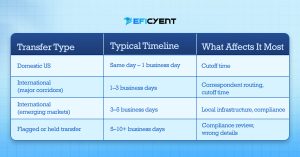
The Honest Summary.
Domestic wires are really fast when you use them the way. You can get your money on the day you send it as long as you do it before your bank’s cutoff time. If you miss that time you have to wait until the business day. It is just that simple.
International transfers are a different pace by design. Two to three business days is a realistic baseline for most corridors. When transfers stretch past that, the cause almost always falls into one of three buckets: a detail in the beneficiary information was off, a compliance system flagged the transaction for review, or a correspondent bank somewhere in the chain is creating a delay.
Before you send any money you should double check the information about the person getting it. Their account number, the SWIFT code and the spelling of their name. You have to get all of that right. If you make one mistake it can turn a two day transfer into a seven day problem. If you need to get the money there fast you should send it in the morning.
If something goes wrong You do not have to sit and wait ask your bank for the transfer’s reference number and request a trace. They can identify which bank is holding the funds.
One thing to remember: if you are paying people in other countries on a regular basis the old way of doing international wire transfers is not really the best way. The delays and the extra steps can cause problems when people are waiting for their pay. There are companies like EFICYENT that have a system for doing international payroll. They can handle everything in one place. Getting the money, changing the currency, and getting it to the people in over 190 countries. They can even find the way to get the money there. If slow international transfers are a recurring problem for your business, a platform like EFICYENT may be worth exploring.