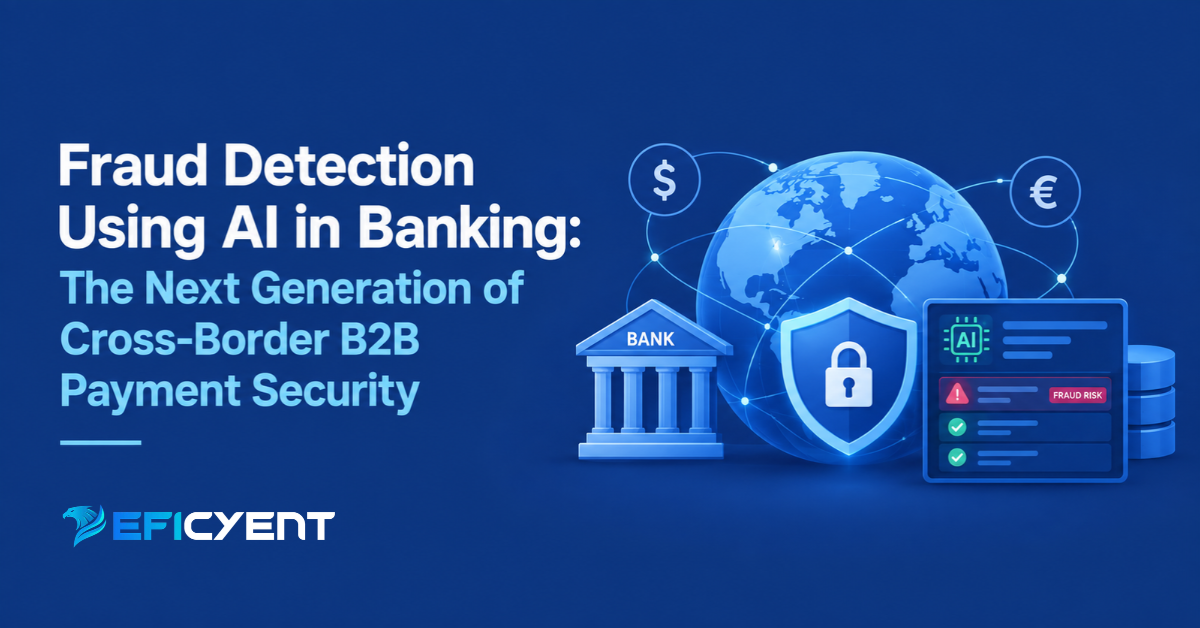
Cross-border B2B payments are growing faster than the infrastructure that secures them. Transaction volumes across currencies, jurisdictions and correspondent networks are growing rapidly, driven by banks and payment providers expanding their cross-border reach. Fraud evolved right along with them faster, more automated, and more difficult to catch with legacy tools. In the case of large B2B transfers, the question for financial institutions is not if they should modernize their fraud defenses but how fast they can do it.
That’s where AI-based fraud detection in banking is turning the tables.
Why Cross-Border B2B Payments Are A Top Target For Fraud
There are three reasons why B2B cross-border payments are particularly attractive to fraudsters: high transaction values, multiple intermediaries and fragmented regulatory oversight across countries. A single wire can pass through multiple corresponding banks to reach its destination, and each handoff is a potential blind spot.
The traditional rules-based fraud detection systems in banking were not built to handle this complexity. They use static thresholds, flag anything over limit, block transfers to specific countries, and manually review new vendor accounts. These rules catch obvious red flags, but miss the more subtle patterns that sophisticated fraud rings exploit: synthetic vendor identities, invoice manipulation, business email compromise (BEC) and layered transactions designed to slip just under detection thresholds.
How AI Alters the Fraud Detection Equation
AI fraud detection is not replacing rules in banking, instead it is adding a layer of contextual intelligence that rules alone cannot provide. Instead of asking ‘does this transaction cross a fixed threshold?’ standard ML models ask, ‘Does this transaction look like this business, this counterparty and this corridor, based on everything we’ve learned?
The key capabilities driving this shift are:
- Behavioral baselining for accounts: Machine learning algorithms build a dynamic profile of normal behavior for each corporate account common payment corridors, invoice amounts, vendor relationships and transaction timing. Deviations are flagged in real-time even in the absence of a technical rule break.
- Graph and network analysis: Machine learning-based fraud detection is increasingly based on graph models that map relationships between accounts, beneficiaries and intermediary banks. This allows investigators to identify mule networks and shell-company chains that are unremarkable in isolation but form a clear fraud pattern in the aggregation.
- Real-time scoring at scale: Cross-border payments happen very quickly, and fraud teams need decisions in milliseconds, not hours. AI models can score transactions in flight, allowing banks to stop fraudulent transfers before they settle, rather than retrieving funds after the fact which is often impossible once money leaves the correspondent chain in cross-border scenarios.
- Adaptive learning Instead of static rule sets, AI models are continuously retrained on new data. As fraud tactics evolve new BEC scripts, new mule account structures cthe models evolve, without requiring a manual rules overhaul every time.
Fraud Analytics Putting Data to Work for You
All of this is held together by fraud analytics in banking. It’s not just about catching bad transactions, but providing compliance and risk teams with the visibility into the whys of why a transaction was flagged, the level of confidence in the model, and what other similar patterns look like across their portfolio.
In the case of B2B banking, strong fraud analytics platforms usually provide the following:
- Explainable risk scores that meet the requirements of internal auditors and cross-border regulators
- Corridor level risk intelligence as fraud trends are very different between say US-India trade payments and intra-EU B2B transfers
- Case management integration so flagged transactions go right into investigator workflows with full context attached
- Reducing false positives, which is critical at B2B scale. A bank that processes thousands of wires a day can’t have investigators drowning in noise.
And that last point bears emphasis. Legacy systems have a reputation for generating false positive rates that cause delays for legitimate B2B payments, frustrating corporate clients who expect predictable settlement times. Well-tuned AI models significantly decrease false positives and improve the rate of true-positive detections, a rare win-win for security and customer experience.
What to Look for in Fraud Detection Software for Banks
Not all platforms are built to handle the complexity of cross-border B2B flows. When reviewing fraud detection software for banks, decision-makers should consider:
- Multi-currency and multi-jurisdiction support, including sensitivity to nuances of local regulation (AML/CFT requirements are diverse across countries)
- API-first architecture that can integrate with existing core banking, SWIFT, and correspondent banking systems without the need to rebuild the entire infrastructure
- Model transparency and auditability as regulators increasingly expect AI-based decisions to be explainable, not black-box results
- Scalability to handle spikes in transaction volume with no degradation in latency
- Regular evaluation of the model to identify model drift before it becomes a blind spot for fraudsters
The Compliance Angle: Why AI Is a Regulatory Asset, Not Just a Defense Tool
For cross-border B2B banks, fraud detection and regulatory compliance are intrinsically linked. AI-powered systems that create clear audit trails and explainable decisions make it much easier to demonstrate compliance with AML directives, sanctions screening requirements and cross-border reporting obligations transforming what was a pure defensive function into a strategic compliance asset.
The Road Ahead
With B2B cross-border payment volumes on the rise driven by global trade, supply chain diversification and faster settlement expectations the winners will be institutions that treat fraud detection as a real-time, data-driven discipline, not a periodic compliance exercise.
AI fraud detection in banking is no longer a futuristic capability; it’s the baseline that competitive cross-border-focused institutions are already building toward. Banks that invest now in adaptive, explainable, network-aware fraud analytics will be best positioned to move money safely, quickly and confidently across borders for their institution, and for the businesses that depend on them.
Looking to take your institution’s cross-border fraud detection into the 21st century? But the right combination of AI-driven analytics, explainable models and corridor-specific intelligence can turn fraud prevention from a cost center into a true competitive advantage.