
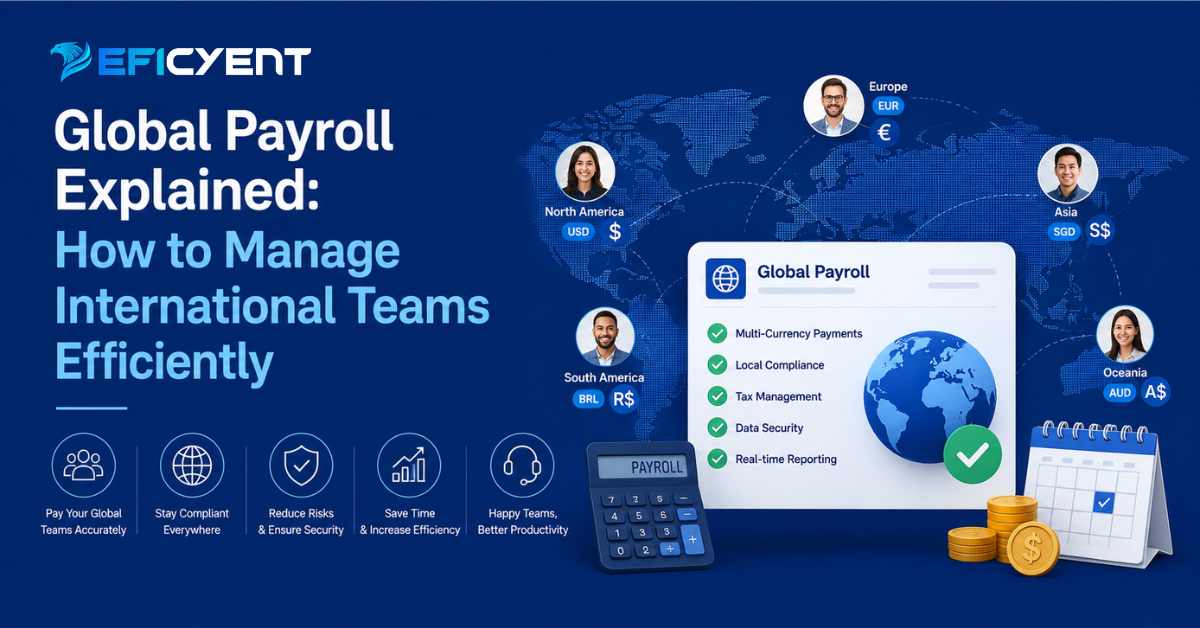
Running a team across countries sounds like a great adventure. And it is. The reality is that it can be really tough. Anyone who has actually done it knows that there are a lot of things to think about and one of the challenges is global payroll.
Getting people paid on time in the currency with the right deductions while following all the laws you may have never heard of. That is what global payroll is all about. It is not the exciting thing to do but it is very important for your company’s reputation especially when you are growing and expanding into new countries.
This guide is going to break down what global payroll actually involves, why it is harder than it looks and how growing businesses are solving it without losing their minds.
Global payroll is the process of paying employees and contractors who are based in different countries. It is so much more than just sending money across borders.
International payroll means calculating salaries in currencies, applying the right tax rates for each country, staying current with local labor laws, filing reports with foreign governments and making sure your employees actually receive what they are owed, without delays, errors, or compliance violations.
Every country has its rules. What counts as a benefit in Germany might not be taxable in Singapore. Severance obligations in Brazil are different from what you would deal with in Canada. Social security contributions in France are structured differently from what you would find in countries like Australia or Canada.
When you are managing multi country payroll you are essentially running several different payroll systems at the same time. Each with its own calendar, its own deadlines and its own legal requirements.
Why International Payroll Is More Complex Than It Looks
A lot of companies do not realize how complex global payroll is when they first start hiring internationally. They assume payroll is payroll. You calculate what someone is owed, you send it, done.
Then reality kicks in.
Here is where it actually gets complicated:
- Tax compliance across different countries. Every country taxes differently. Some have flat rates, others have progressive brackets. Some require monthly reporting; others are quarterly. Miss a deadline in one country and you could be looking at penalties that eat into your profits fast.
- Employment classifications. Misclassifying a worker as a contractor when the local government considers them an employee is one of the expensive mistakes international companies make. Penalties can be severe. They can also trigger audits.
- Currency volatility. Exchange rates move constantly. What you have budgeted for a hire in one currency might look very different by the time payroll actually runs. This has an impact on your cost-per-employee projections.
- Statutory entitlements. Mandatory paid leave, health contributions, pension schemes, 13th-month pay. These vary wildly by country. They are often non-negotiable by law. Your global payroll management process has to account for all of them.
- Data privacy regulations. Payroll involves personal data. Laws like GDPR in Europe, Thailand’s PDPA and Singapore’s PDPA and a growing number of data protection laws mean you need to think carefully about where payroll data is stored and who can access it.
How Companies Handle Global Payroll
There is no right way to manage international payroll processing but there are a few common approaches. Each with its own tradeoffs.
- Some larger companies build international HR and payroll teams. If you have a lot of employees across different countries and the resources to support it this gives you maximum control and customization.
- The downside is that it is expensive. You need local expertise in each market which often means hiring locally or partnering with local accountants and legal advisors. You also take on compliance risk.
- Some companies use a local payroll provider in each country where they operate. This can work well in individual markets but coordinating between multiple global payroll vendors quickly becomes a management nightmare. Unlike dedicated multi country payroll providers, these fragmented setups create data silos, reporting gaps and limited visibility .
- Employer of Record (EOR) Services are used by companies that want to hire without setting up a legal entity in each country. An Employer of Record becomes the legal employer in that country. They handle payroll, taxes and compliance on your behalf while you manage the day-to-day work.
- EOR is increasingly popular for global payroll scenarios especially when you are testing a new market or have a small number of employees in a given country.
- Global Payroll Platforms are where most growth-stage and enterprise companies are heading: an international payroll software platform that consolidates payroll across all countries into one system.
- The global payroll providers give you a dashboard, automated compliance updates, currency management and integrations with your existing HR and finance tools. Instead of managing a dozen disconnected systems, you get one source of truth.
The best global payroll providers give you in Global Payroll Solutions are:
If you are looking at payroll solutions the things that matter most are not always the things that the salesperson talks about.
Here is what you should really look for in global payroll :
Compliance automation.
Tax laws are always changing. You want a platform that updates itself when the laws change. You do not want to have to stay on top of all the changes. The best global payroll systems have experts who keep the platform up to date with the laws.
Coverage breadth.
How many countries does the platform really support? Or is that support only surface-level? A provider that says it supports 150 countries but only really works in most of them is not as good as one that works well in 60 countries.
Integration with your HR stack.
Your global HR payroll system should work with your HR tools and finance software. If the systems are not connected you will have to enter data by hand which means you will make mistakes.
Visibility.
Payroll providers that give you reports on costs by country employee numbers and compliance status are more valuable than ones that just do payroll. This is especially important for finance teams that need to understand labor costs.
Employee experience.
Your employees should be able to see their pay slips, understand their deductions and look at their pay history without having to ask HR every time. A self-service portal in multiple languages really matters.
Support quality.
When something goes wrong and it will, how helpful and knowledgeable is the support team? This is especially important when there are compliance issues in countries your team does not know well.
Remote Global Payroll: A Growing Priority
More and more people are working remotely which means there is a need for global payroll infrastructure.
When your team is spread out across different time zones and you have employees in different countries, the old way of doing payroll with spreadsheets and email does not work. You need a payroll system that was designed for this, not one that was adapted to handle it.
Companies that are remote-first often want payroll systems that are flexible, fast and transparent. They want to be able to hire people, pay them accurately and make sure they know that the administrative side of their job is taken care of.
The platforms that work best for this are usually cloud-based, have APIs, and support various types of employment arrangements like part-time, contract and hybrid setups.
Common Mistakes to Avoid in Global Payroll
Companies that try to do global payroll management often run into problems. Here are some common mistakes:
Treating payroll as a finance problem. Payroll is related to HR, finance and operations so if it is separate things can go wrong.
Not realizing how expensive it can be to not comply with laws. Fines, back-pay corrections, and damage to your reputation from payroll mistakes can be significant. It is rarely worth saving money on software to risk not complying with laws.
Not planning for currency changes. If you pay employees in local currencies but your revenue is in USD or EUR, changes in exchange rates can affect your labor costs significantly. Good global payroll service providers offer Smart FX tools like currency accounts and hedging options to protect your budgets from volatile exchange rates.
Not adapting to laws and customs. Using the same employment terms or benefit structures across all countries can cause problems, and sometimes legal issues. Local employees notice when their employer does not understand the norms.
Not managing change well. When you switch payroll systems or start using a platform the transition period is when mistakes happen. You should have a plan for migrating to the system and communicate with employees ahead of time.
How EFICYENT Approaches Global Payroll
At EFICYENT the approach to payroll is built around one core idea that is international teams should not have to fight with their payroll infrastructure. It should just work.
That means giving HR and finance leaders a platform that handles international payroll processing across markets without requiring deep local expertise on your side. It means staying ahead of compliance changes so you are not caught off guard. It means giving employees a transparent and reliable experience. Because how people feel about being paid is directly connected to how they feel about working for you.
Whether you are running payroll across five countries or fifty, the goal is accuracy, compliance and confidence.
The Bottom Line
Global payroll is one of those challenges that often gets underestimated until it becomes a real problem. By the time you are dealing with compliance penalties, delayed payments or frustrated employees in multiple countries, the cost of not having the right infrastructure in place becomes obvious.
Getting ahead of it with the right global payroll service, technology, and processes is one of the best investments a scaling company can make. It protects your people, protects your business, and frees your team to focus on growth instead of administrative firefighting.
If you are evaluating your international payroll setup and wondering whether there is a better way it is probably worth the conversation.